
Week 1
Reading: What is documentary?
Most of the documentarians agree with the spirit of documentaries: documentaries explore the mysteries of actual people in actual situations, while the disagreements arise over allied issues
- What any given actuality really is
- How to record it without compromise and without injecting alien values
- How to honestly and truthfully convey something that being more spirit than materiality, can only be discerned subjectively
Documentary as the creative treatment of actuality. Considered by John Grierson, the founder of documentary, documentaries should be shooting the actual rather than bring the subjective delusion of documentarians to the real.
Documentary and time: Most of documentaries recorded the past or present as they were actually happened or happening. But there is in fact no rules in the time field of documentaries. Example: War game (1965) by Peter Watkin
Documentary is socially critical: Documentaries should be meaningful rather that just full of real and meaningless shots. “Concern for the quality and justice of human life lifts the documentary out of the purely factual realm and propels it into moral and ethical dimensions. There, it scrutinizes the organization of human life and attempts to develop a humane consciousness in its audience.” So that a real documentary should be critical and meaningful for the society, out of fully recording of truly things and develop the central ideas of itself.
Documentary, individuality, and point of view: “Documentary is a corner of actuality seen through a human temperament.”Documentaries, like artworks, contain the personal characteristics and temperament of the documentarians.
Documentary is an organized story: Great documentarians should know what they want to present to the audiences before they start shooting. A documentary, like the simple films, could contain engaging characters, narrative tension, and an integrated point of view.
Documentary’s range of forms: Almost no limitation.
Fidelity to the actual versus realism: There is no limits to the documentary’s possibilities, but it always reflects a profound fascination with, and respect for, actuality. True documentary reflects the richness and ambiguity of life, and goes beyond the guise of objective observation to include impressions, perceptions, and feelings.
Documentary as unfolding evidence: Documentary could be evidences of the arguments in real life, but considered about the contrast and contradiction showed in, these evidences could be weak or strong.
Documentary as a social art: An authorial attitude arises and is collectively mediated by the individuals who shoot and edit the film. Anther collective-audiences-then considers the resulting work.
The corollary is that documentary makers must labor harder than fiction filmmakers to raise their films’ significance beyond the parochial. Documentary, as it introduced beyond, is more than filming actual things or situations. The authenticity of documentaries is significant, but it never means there is no need for storyline. I watched a documentary produced by Netflix this week named Making A Murder, it is a great documentary which combines authenticity, storytelling and artistry, and the reviews of this documentary also shows its socially critical.
In this week module, our team shoot a short video which contains 5 types of shooting mode. Panning shot, tracking shot, point of view, and close up. There is the video below.
For the first scene, we use panning shot to show the whole setting of the space. Then it is both tracking shot and point of view, showed the trajectory and other’s view. The next shot, to show the details of this scene, we use close up to focus on it.
Week 2
Camera Techniques: Angles
Long shot extremely shows a fairly large subject and usually much of the surroundings. It is also referred to as a “wide shot” or “full shot”. In this type of shot the camera is at its furthest distance from the subject, emphasizing the background. Medium shot shows the subject or actor and its setting occupy roughly equal areas in the frame, it is usually filmed from a middle distance and move us a little bit closer to the subject compared to the long shot. Generally, this shot is used to display characters’ actions or objects acting on a character. The close up presents a picture which shows a fairly small part of the scene, such as a character’s face, in great detail so that it fills the screen. It is, without a doubt, the most important shot type to show dramatic elements, reactions, or emotion.
There is a video example helps to understand these three types of camera techniques.
The point of view shot shows what the subject is looking at, represented through the camera. This is heavily used to show sports action and moments of reveal when a subject finds something new in the scene. It is a shot made from a camera position close to the line of sight of a performer who is to be watching the action shown in the point-of-view shot.
There is a video to introduce the point of view shot.
The high angle shot needs high height of the camera, and the camera looks down at the subjects to provide a powerful feeling to audiences, or suggest an air of detachment. A low angle shot places the camera below the subjects, to exaggerate their importance.
There are two videos to introduce the high angle shot and low angle shot.
High angel: https://youtu.be/b-nqxw9mvn8
Low angel: https://youtu.be/HnZsFS8I4bQ
Camera Techniques: Movements
The panning shot means swiveling a still or video camera horizontally from a fixed position. Like the picture below. Panning shot could give the shot a feeling of movement and speed, it is also easier to show the details of the scene. The panning shot is different from the tracking shot as the camera is just swiveled but is not physically displaced left or right.
There is a video to show what panning shot exactly is.
The tracking shot is any shot where the camera follows backward, forward or moves alongside the subject being recorded. Filmmakers use tracking shot to highlight what the subject is doing, the details and the movement of the subject.
The best example for tracking shot may be in the film Rocky (1976, dir. John G. Avildsen). It is when the Rocky doing his morning exercise, the camera followed him all the time to show his movement.
The pull focus/racking shot is to change focus during a shot. Usually this means adjusting the focus from one subject to another. It is hard to explain, so the video below could present what it really is.
https://www.youtube.com/watch?v=Kb8QmEZjcto
Week 3
Reading: Location Sound (this page has been modified after week 10)
When audiences watch a documentary, they won’t want some ear-piercing noises, but they do need some background sound to give them empathy of the film. In this situation, the location sound could play a key role. Location sound, also refers to ambient sound, is the sound inherent to any location. For examples, the collision sound of knife and fork in a restaurant, the sound of every pace of a passerby, or the talking of anyone outside the screen. The location sound could be everywhere you shoot. Ambient sound is the sound of the environment where your are going to shoot. It has to be recorded because every location has its own unique and changing ambience. The track which record the ambient sound is the presence track. The environment should be relatively silence during the recording of the presence tracks, which means everyone should not make any sound.
As it has already been suggested, the ambience is sometimes important for a film. Audiences will accept some ambient atmosphere as part of each sequence’s reality. The ear would select it and screen it out. And sometimes, consider it as part of the film. But when the angle environment changed, they may feel intrusive, and consider it as unexpected sound. So the background sound should be edited to fix it.
To fix it, it is necessary to use the presence tracks. The editor must work to make every angle’s background match the sound as the postproduction can only add but can not remove. So they should record more presence sound tracks in many angles to suit different situations becomes the vital materials from which to build.
In editing part, it is necessary that not to cutaway all the ambient sound. Just like when you use a cutaway which was shot silent but it couldn’t be totally silence in real life. So you need add ambient sound to make it constant in the films.
Research: The different documentary modes of representation
Four modes of documentary: Expository Documentary, Observational Documentary, Participatory Documentary, and Performative Documentary.
The expository documentaries speak directly to the viewer, often in the form of an authoritative commentary employing voiceover or titles, proposing a strong argument and point of view. This kind of documentaries are rhetorical, which means they suggest the questions, and then give the answers to audiences, because they want to persuade the viewers. The expository documentaries are also called as “voice of god”, as they are processing to speak to viewers on a higher position, the purpose of this kind of documentaries is to teach the audiences, they can do this because they are more professional in this area. One example is America’s Most Wanted, directed by Tony Playboy in 1990. There is always a guide to introduce the information through the whole documentary, and he is on the higher position to tell the audiences what they don’t know.
There is the link to this documentary: https://m.youtube.com/watch?v=9BEvvKHWy-U
The observational documentaries aim to simply observe the world around them. This kind of documentary docs strive for cinematic realism, this is why it is called as fly-on-the-wall, as the one who filming it are not a joint part of the documentary, they don’t put their oar in the growing of the story but just record it. The gritty realism produced by actuality film makers of the 1960s and 70s was achieved through technological advances made ten years earlier. One example is Salesman, filmed in 1969, exactly when observational documentaries rise. The producers only recorded the reality during the whole film.
The Participatory Documentary is an inclusive and collaborative process that engages communities in designing and carrying out the collection and dissemination of their own story. In my view, this kind of documentaries are more likely to appear in the biography kind of documentaries, it contains both realistic and story. It is more likely to tell the story past, so they are probably using the resources like videos or pictures to support their documentaries. One example is Life of Michael Jackson By Bashir (2004), the subjects of this topic is introduced by a montage of videos of Micheal Jackson.
The performative Documentary is the direct opposite mode of the observational ones where unobtrusive observational of the subject is the director’s aim. This kind of documentaries emphasize the filmmaker’s own involvement with the subjects. One example could be Supersize Me, a 2004 documentary directed and starring by Morgan Spurlock, follows a 30-day period from February 1 to March 2, 2003, during which he ate only McDonald’s food. As its influence to society that all the supersize meals are forbidden, it shows the socially critical quality of documentaries.
Week 4
Lecture: Interview
Reading: Point, Line, and Plane. Rhythm and balance.
Point, line, and plane are the building blocks of design. A professional photographer is not just shooting something or someone, he or she has to combine all these elements to make the works creative, aesthetic, and contains visual balance.
A point marks a position in space, in pure geometric terms, a point is a pair of x, y coordinates. A line is the connection between two points, or the path of a moving point. And it appears at the edges of object and where two planes meet. A plane is a flat surface extending in height and width, and it is the path of a moving line.
Point, line and plane play a significant role in shooting, things should be set compliant by rules which basic on them. In photography area, the picture would be divided into nine parts by trisection lines. The rule of thirds contains point, line, and plane as its basis. It is a “rule of thumb “or guideline which applies to the process of composing visual images such as designs, films, paintings, and photographs. The horizon sits at the horizontal line dividing the lower third of the photo from the upper two-thirds. It supposes that the most attractive position to human beings’ eyes is the point as the pair of two lines. So it is important to set the things you want to highlight on these positions. For example, when you are filming an interview, the body of interviewer should occupy two parts of three horizontal planes, the eyes should be always on the lines. An other rule of filming is the 180 Rule, it says that two characters in a scene should maintain the same left/right relationship to one another. When the camera passes over the invisible axis connecting the two subjects, it is called crossing the line and the shot becomes what is called a reverse angle. Mise-en-scene is also an important part in digital video. It means the arrangement of everything that appears in the framing, no matter actors, lighting, props, or costume. Everything that has to happen to make the finished image look the way it looks, which in turns helps you content feel the way you need.
Balance is a fundamental human condition, when it comes to cinematography area it means that the relationships among elements on the page or screen show a visual balance. The elements could be colors, shapes, space, etc. Visual balance occurs when the weight of one or more things is distributed evenly or proportionately in space. Rhythm is a strong, regular, repeated pattern. Speech, music, and dance all employ rhythm to express from over time.
Week 5
Working title: The sea food culture of Brighton
Director: Renee Luo
Sound: Irene_Chen
Others (Role): Camera: Perilu
Sound: Irene
Editor: All of the group
Researcher: Kari
Interview: Celeste Guo
Format: Documentary
PROPOSAL ORGANIZER
- WORKING HYPOTHESIS and INTERPRETATION. What are your per- suasions about the world you are going to show in your film, the “state- ment” you want to emerge out of the film’s dialectics? Write a hypothesis statement that incorporates the following wording:
- In life I believe that (your philosophy regarding the particular life- principle that your film will exemplify)
In life I believe that sea food is a great part of Brighton,and there are a great amount of worthy things to shoot through this topic.
- My film will show this in action by exploring (situation)
My film will show this in action by exploring the economic,political and cultural research of sea culture in Brighton, both historical and present sides.
Economic: What economy does sea food provide?(Such as sea food, tourism, ship industries)
Political: Does law of the sea a limitation to the development of sea food in Brighton or it is a protection?
Cultural: Research the arts which created because of the sea.
- My film’s main conflict is between seafoodand Brighton (such as economy, culture, and environment).
- My film’s point of view, or its POV character, will be the seafood, the fishermen, the workers in the fish sales industry, and the workers in the restaurant.
- I expect my film’s structure to be determined by the processes of seafood industry.
- The subject and point of view suggest a style that is peaceful and exploratory.
- Ultimately I want the audience to feel it is a promotional film for Brighton as well as a narrative and commentary for Brighton seafood culture, and I want the audiences to feel that they get something during the documentary.
- . . . and to understand the information like the export and import of seafood industry, the seasonal issues of seafood, and that seafood culture is a glorious part of Brighton.
- TOPIC and EXPOSITION. Write a paragraph that includes
- Your film’s subject (person, group, environment, social issue, and so on)
- Expository information (factual or other background information) so that the reader can see the enclosed world into which you are going to take us
Brighton, as a seaside city, occupy a large part of seafood industry in UK. The research shows that the sea here has less Cadmium level than Scotland and many other cities in UK, and it brings a better environment for seafood to grow. Our documentary aims to describe the processes of seafood industry, the subjects involved would be the fisherman, workers in fish sales and restaurant, and the seafood. And also in interview part, we would ask the question about the culture and economy in Brighton which has been influenced by seafood industry.
- MAIN CHARACTERS. Write briefly about each main character, including
- The person’s identity—name, relationship to others in film—and his or her qualities
- What he or she contributes to your film’s story
- The metaphoric role you see this person occupying in relation to what else is in the film
- What this character wants to get or do in relation to the others or to the situation
- Any direct speech quotation that freshly and directly conveys what this person is about
As it is a documentary about non-human subject, the main character in this documentary could be the interviewee, Jim Partidge. He is a holder of the biggest lobster supplier factory, and he contributes to our documentary by giving a range of useful information such as the environmental benefits in Brighton for seafood industry, and the seasonal issues of seafood.
- SOCIAL SIGNIFICANCE. What will this film say about the lives it portrays, and what is the social significance of this? Why should people care to watch this film?
As it has been said, this documentary aims to give a critical introduction to the seafood industry in Brighton. It is a narrative of the subject, so the only key point of our portray is “real”. We are presenting reality to the audiences, so the target audiences would be the ones who have interest with the processes of seafood industry, and even the ones who live in or have connection with Brighton city.
- YOUR MOTIVATION FOR MAKING THE FILM. What, in your back- ground and interests, impels you to make the film? This indicates whether you have the energy, passion, and commitment to stay the course and make an outstanding film.
Firstly, I was not the one to choose this topic. But this topic did attract me for many reasons. Seafood is a great part of Brighton, and there are a large amount of elements can be detailed through this topic. On the other hand, there are many people in Brighton have seafood, do they all have awareness about the seafood industry which is closely related to them? The motivation of me is to teach them something brand new, and after them watch this documentary, they would be surprised and say, “I don’t even know that!”
- AUDIENCE, ITS KNOWLEDGE AND PREJUDICES. A documentary should anticipate the expectations—both right ones and wrong—of its audience. Your film is in a dialogue with these prejudices and must extend, subvert, or endorse them. Complete the following:
- My intended audience is (don’t write “Everyone!”) the ones who are interest with this topic, and the ones who have close relationship with Brighton seafood.
- B I can expect the audience to know the processes of seafood in Brighton, but not to know the details which are not concerned in the documentary, such as the introduction of one special kind of seafood.
- I assume positive audience prejudices are that they really got something through this documentary, and negative ones are feeling it is boring and with no meaning.
- Countervailing facts, ideas, and feelings that my audience needs to experience are the seafood is a glorious part in Brighton.
Presentation
The task of this week is our presentation for the documentary. The topic of our documentary is the seafood culture in Brighton, and we choose this topic because that Brighton is one of the biggest seaside city in the UK, it holds a large part of British seafood industry as well.
Our presentation presented the information about our division of work, the topic and its meaning, and the further details about each part for each one. Kari will do the research work, Renee and Perilu will be the main director during shooting, Irene will deal with the sound of documentary, and I will focus on the interview part, for examples, what questions would be asked and who would be interviewed.
I believe that we would making progress in the next few weeks to complete our work.
Week 6: Reading week
Unfortunately during this week I had no chance to join the teamwork with the shooting of our documentary. Our members went to the New haven fish sales to framing, and they got some shots about how the workers dealing with sea food and the video of some equipment they have. During this week, I kept completing the proposal organizer of our film, as well sort out the shots we may have to shoot. Also, I have already done some of the timeline yet.
Week 7
Editing
We started the editing work, but there are still some needed shots we haven’t got. As a result during this week we went to Marine to film some seafood market and some scene of the sea. We will shoot these as soon as possible.
Reading: Screen Grammar: Editing
Editing in film are is the process of selecting and preparing film media used to convey information.
A film transition is a technique used in the post-production process of film editing and video editing by which scenes or shots are combined.
Crosscutting is kind of editing that alternates shots of two or more lines of action occurring in different places, usually simultaneously. The example provided was YI YI by Taiwan director Edward Yang, it is worth mention that this film is one of the best Chinese films during last few decades. In the clip, father and daughter go out on dates at presumably the same time, while they were in the totally different locations.
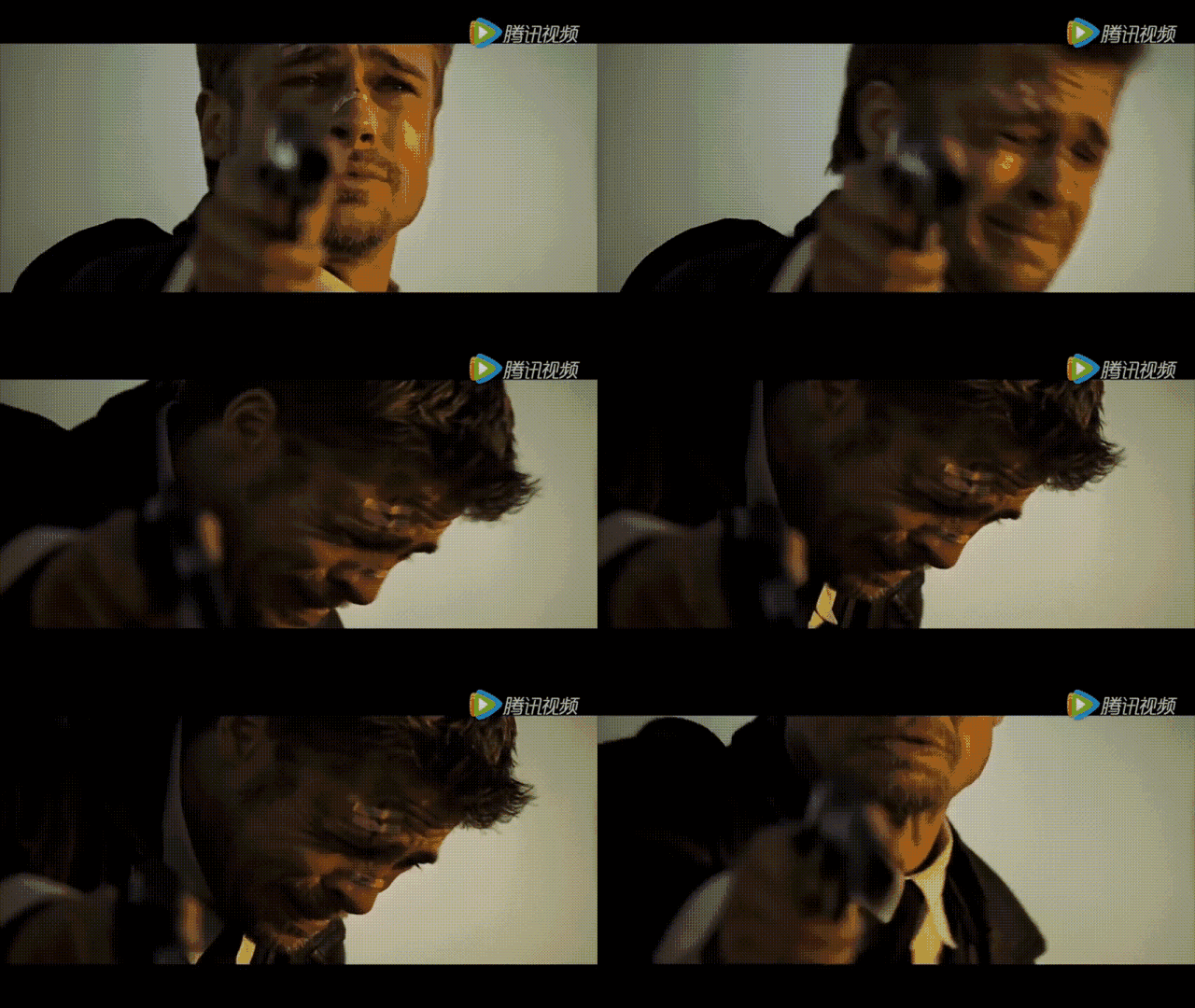
Cutaway is a process that cut in a frame and soon cut back to the origin clip. It is an instantaneous shift from a distant framing to a closer view of some portion for the same space. There is an example for this kind of editing, it is a clip from Se7en (America, 1995).
Jump cut is a cut in film editing in which two sequential shots of the same subject are taken from camera positions that vary only slightly if at all. The example could be in the movie Breathless(France, 1960). During the whole movie, Godard used a large amount of jump cut to show the lapse of time. Another reason was that he could use jump cut to short cut the duration of the movie, as well saved a range of expenditure.
Smash cut is the editing that connect two cuts that not related to or be coherent to each other together base on aesthetic, narrative or emotional expression. For example, image the scene that the character is experiencing a terrible situation, while he or she wakes up and find it is a dream. The one cut transition directly to the other cut, this is the smash cut.
L-cuts is the editing that the sound match the scene while the transitions don’t match these. It means that audiences are listening to the sound match the last scene, while the video is turning to the next clip. J-cuts is exactly the opposite side of L-cuts, it is the editing that the scene changes, while the sound is still continuing.
Week 8
This week we are continually doing our filming works as well editing some of the documentary. And we went to the Brighton Marine to shoot more clips, however, we got only few shoots that may be suitable for our documentary. But we are making progress.
Here is the video I shot on the boat, and we got some clips about landscapes which could be useful materials for our documentary.
Week 9
Task: Editing
This week we finished two interview parts in our documentary. The first one is a holder of a seafood restaurant, Kay Kolakovich. She gave us a large of information about the classification of seafood, the seasonal details of seafood, as well introduced us to the other one who be interviewed by us, Jim Partridge, a person who own one of the biggest lobster industry in Brighton. And he talked to us about how the environment in Brighton suit the seafood industry, and how about the export and import of seafood in Brighton. Thanks them a lot, we got many materials for the documentary.


Also during this week, we decided to use a time-lapse video to be the ending of our documentary. We stand outside for two hours and finally complete it. It is a clip of sunset, signify the end of a day, while we all know the sun would rise tomorrow and the process of seafood industry is repeatedly.
Week 10
Tutorial
In the tutorial this week we showed teacher the miniature of the documentary. Absolutely we still got many problems, the one stand out is the ambient sound. To do the noise reduction, we move out all of the background noise directly. However, it could provide an unrealistic feeling to audiences, as it is not possible that a place is totally in peace. While documentary, as we all know, aims to filming reality. Fortunately these problems are not impossible to deal with.
TO DO:
- Finish the editing
- Add the ambient sound
- Do the dubbing part
- Find more materials for the interview
- DVD Cover
Week 11
DVD Cover
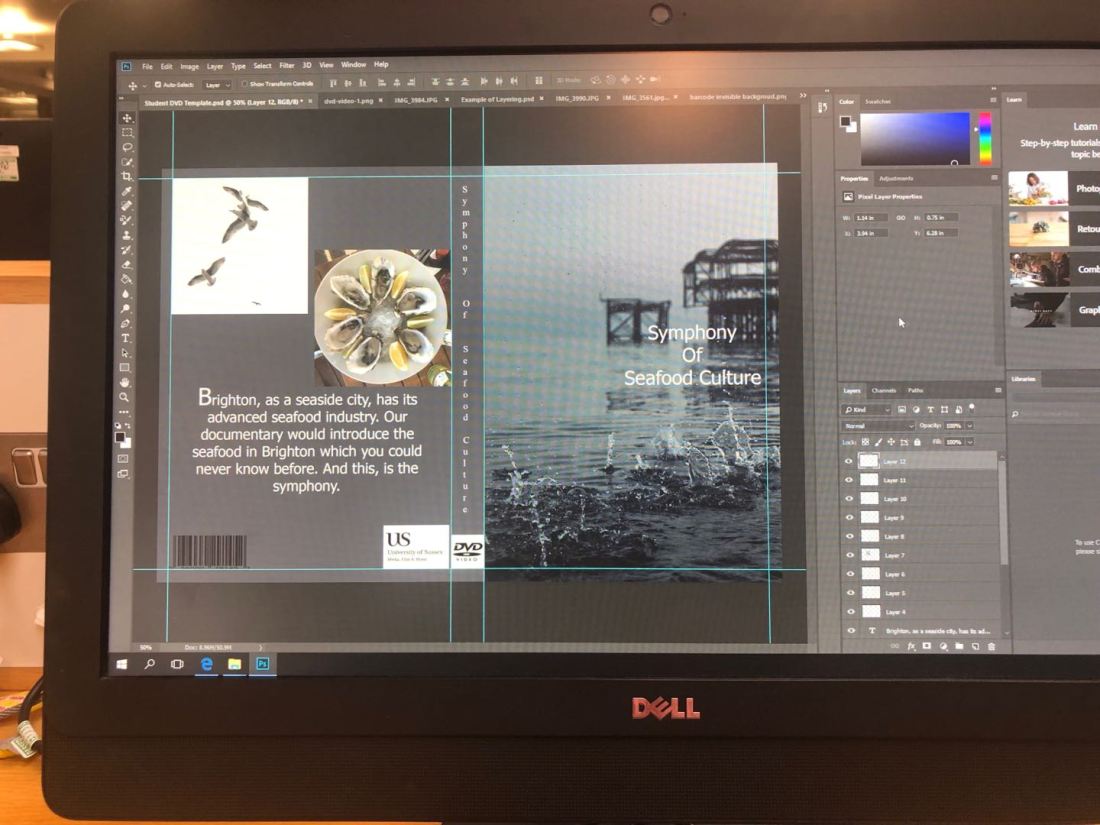
In this week, I completed my DVD Cover, but there could be something that need edition.
To do:
- Finish the editing. We have soundtrack editing and some shots to correction.
- Do the dubbing part.
- Find more materials to fill in all the space in interview part.
Week 12
Editing
Here is the work as far as we did.

It is presented that we already do a large part of this documentary, such as the adjustment of sound, the videos should be inserted, and almost all of the interview part. Thanks to all of our members, and hope the final work is perfect.
TO DO:
- Subtitles
- Some details
 PulpFiction